

What is Dry Needling and How is it Different From Acupuncture?
The History of Dry Needling
While some people think of dry needling as being a new “fad” treatment, or a modality inspired by acupuncture, it has actually been around for almost 50 years, is rooted in Western medicine, and based on scientific research-based conclusions. The only similarity is that they share a tool (the needle).
Dry Needling came into play when a Czech physician Dr. Karel Lewit published an article “The Needle Effect In The Relief Of Myofascial Pain,” demonstrating pain relieving effects on painful spots (ie trigger points) from the needle alone. He proved that without injecting medication, the needle provided relief by a mechanical stimulation hitting the muscle knot.
From 1980 to now, practitioners have been using thin, solid, filiform needles (same as used in acupuncture) to release muscle tension and improve pain in people with neuromuscular and musculoskeletal conditions.
New Jersey and Dry Needling Drama
New Jersey has had a notorious rocky relationship with dry needling. For years, physical therapists were using this under their broad scope of work, but turf wars began with acupuncturists, and the New Jersey Attorney General ruled that dry needling was not within the PT scope of practice, and it suddenly came to a halt from 2017 to 2022.
Finally on January 18, 2022, after a long fight with American Physical Therapy Association of New Jersey (APTA-NJ), Governor Phil Murphy signed a bill explicitly permitting licensed physical therapists to perform dry needling.
New Jersey now has some of the strictest standards in the country. To legally practice dry needling in NJ, a physical therapist cannot just start poking; they must:
Hold a Doctorate of Physical Therapy (DPT)
Have at least 2 years of active clinical experience.
Complete a Board-approved continuing education program consisting of at least 80 hours of in-person, hands-on academic instruction, and maintain the certification every 2 years with continuing education
Today, dry needling is fully legal and widely used across New Jersey clinics, though a handful of states (like New York and California) still do not allow PTs to perform it.
Now what exactly is Dry Needling and what can it treat?
Dry Needling refers to the insertion of thin monofilament needles without the use of injectate.
It’s typically used to treat muscles, ligaments, tendons, subcutaneous fascia, scar tissue, peripheral nerves, and neurovascular bundles for the management of a variety of neuromusculoskeletal pain syndromes. Some of these include:
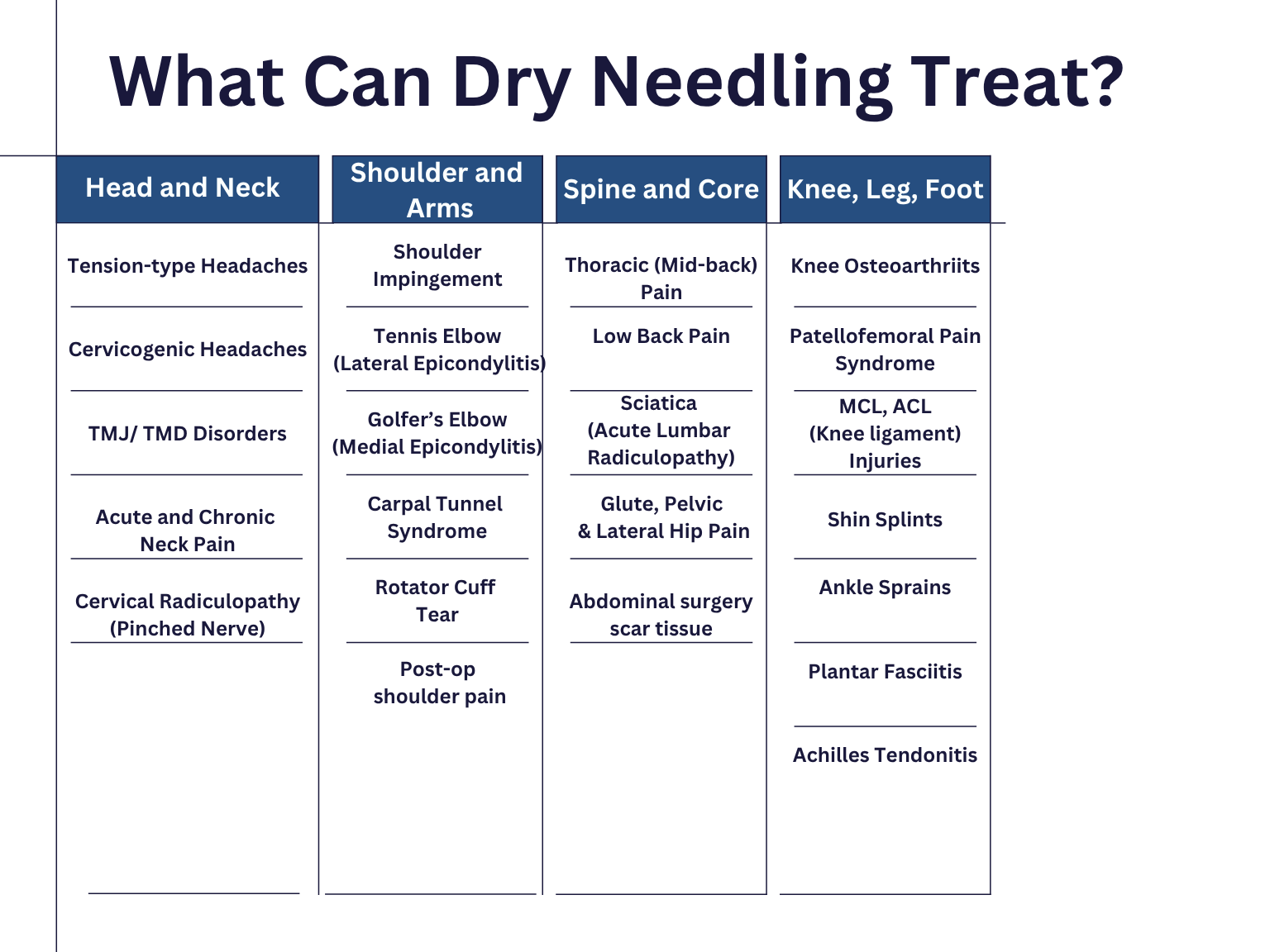
Common Diagnoses that are treated with Dry Needling
Based on your condition and symptoms, and a thorough evaluation, needles are inserted in the dysfunctional tissues, and typically left “in-situ” meaning in-place for anywhere from 10-30 minutes.
How Dry Needling Tricks Your Body Into Healing Itself
Flooding the muscle with fresh blood and oxygen: When you have a painful muscle knot, the tight fibers contract so hard that they compress nearby blood vessels, starving the tissue of oxygen and trapping irritating, painful chemicals. Dry needling helps by breaking up this tight contraction, which prompts local blood vessels to open up and deliver a rush of fresh, oxygen-rich blood to flush out those trapped pain triggers and accelerate healing.
Releasing your body's built-in painkillers: The physical stimulation of the needle prompts your nervous system to release its own powerful pain-relieving chemicals. This triggers a release of endorphins and opioids—your body's natural version of morphine—alongside brain chemicals like serotonin and norepinephrine that naturally dull the ache.
Turning down the volume on over-sensitive nerves: Chronic muscle pain can cause your nerve pathways to become hyper-sensitive, keeping your body stuck in a state of constant, irritated alarm. The movement of the needle interacts with specific nerve receptors and boosts a natural compound called adenosine, which essentially acts like a volume knob to quiet down those hyperactive, misfiring nerves.
Blocking pain signals before they reach the brain: Dry needling activates fast-acting sensory nerve fibers. This activation sends quick signals to your spinal cord that effectively "close the gate" on the slower, throbbing pain signals coming from your muscles, preventing them from traveling up to your brain.
Putting the brakes on swelling and inflammation: The treatment triggers a cellular response that lowers the production of local and body-wide inflammatory proteins and enzymes (like COX-2). This provides a natural anti-inflammatory effect that helps decrease swelling and irritation, providing relief not just to the muscle tissue but to surrounding joints as well.
How does Dry Needling differ from Acupuncture?
Underlying Philosophy
Dry needling by a PT is based on western medical science, rehab science, anatomy, and neuromusculoskeletal expertise.
Acupuncture is a cornerstone of TCM (Traditional Chinese Medicine). It is rooted in eastern principles of the body’s Qi (energy flow) and based on meridians and specific points.
Needle Placement
Acupuncture needles are placed based on acupoints and meridians.
Physical therapists place needles based on your injury state, function, tissue health, and anatomy.
Number of needles and needle depth also vary.
Treatment Scope
While both are appropriate for pain, acupuncture can also be used in the management of hormones, organ health, digestion, allergies, sleep, fertility, stress, and mental health.
Dry needling by a physical therapist focuses on pain, specific musculoskeletal injury, neuromuscular function, tissue health, recovery, and performance.
Patient Experience
There are multiple needle methodologies for both acupuncture and dry needling. Not all PTs needle the same way just like not all acupuncture sessions will be the same.
In general, patients who have experienced both will acknowledge that acupuncture treatments are often more gentle, potential due to the more shallow needle placement.
Dry needling potentially involves more soreness from deeper needle placement.
Ready to target your pain at the source?
If traditional treatments haven't cleared up your muscle tension, dry needling might be the missing piece to your recovery.
Let the expert dry needling techniques at Paglia Rehab help you find lasting relief.
